Words
An Improvised Audience With Bettina Varwig and Friends
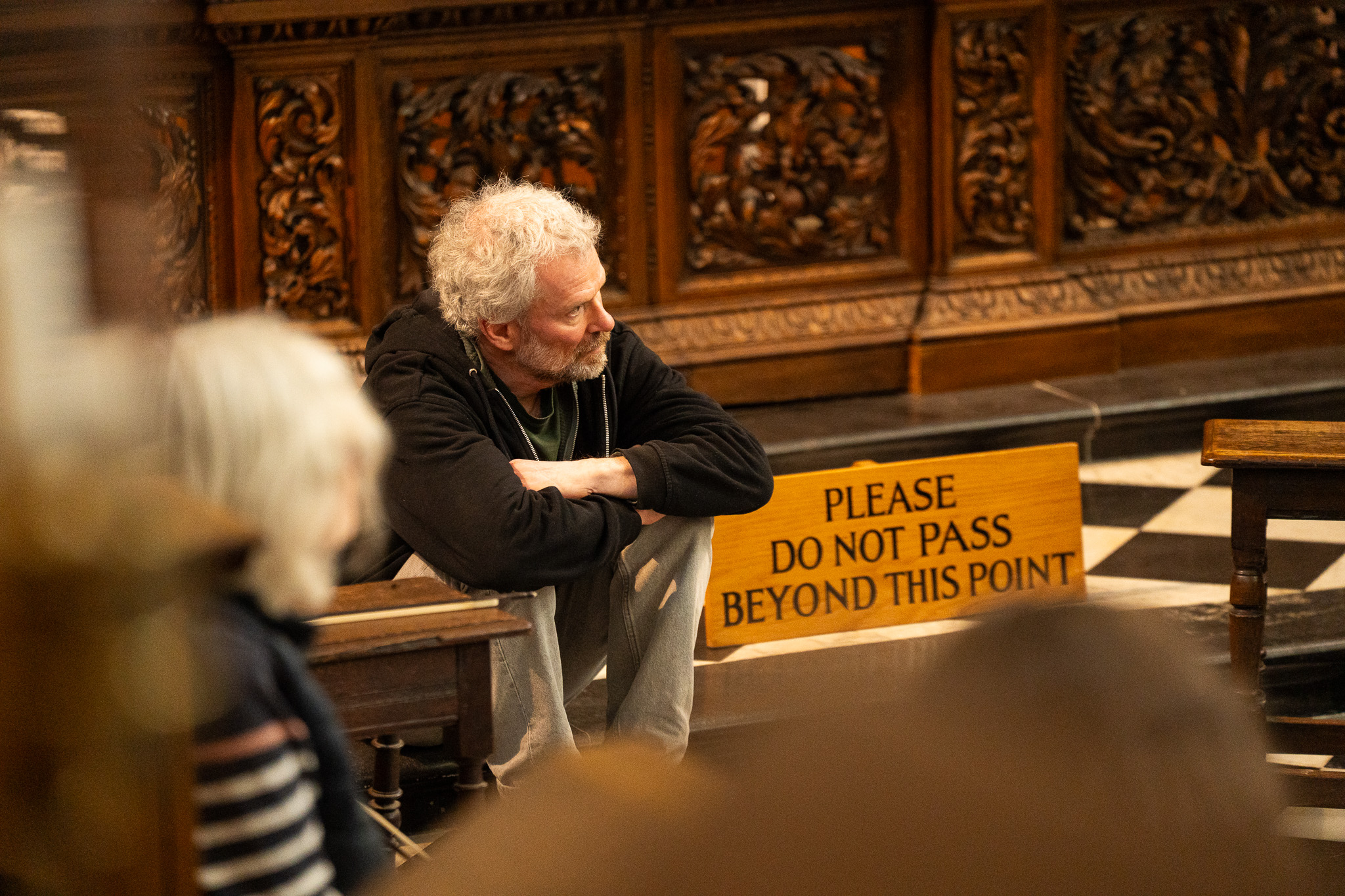
An Improvised Audience With Bettina Varwig and Friends.
James Waite
Cambridge Music Festival
March 17th 2026
In pursuit of a conclusion, the labyrinth of academic writing can pull reader and author alike around diverse, sometimes contradictory, circuits. Linguistic protocols and clear epistemological rules prompt just where to plant one’s feet on the shoulders of which particular giant, and tend to lock enquiry inwards to a highly specialised discourse space. And while this kind of qualified reflection and scrutiny reinforces the best standards, the price is often a glacially-paced percolation towards public recognition and enjoyment.
On the face of it Music in the Flesh, Bettina Varwig’s remarkable work on the embodiment of music by both performers and witnesses in the early modern period, is just such an enterprise. Rich and nutritionally dense, it is liberally studded with examples and quotations that conjure the past as an anthropology of experience rather than arm’s length historiography. The fluids, fibres and meaty parts that coalesce in performing, seeing and hearing - in musicking - are alive in the prose, seeping through and winding around its exemplary academic scaffolding to create a humid ecosystem, teeming with possibility. But it’s a relatively demanding encounter, rewarding scholarly engagement with the ingredients of reflection, but offering the general reader less to carry away.
Despite her insistence that she is working with neither metaphor nor fiction, but a physically felt corporeal reality, Varwig must nevertheless pass through the illusory portal of the disembodied mind to advance her thesis. The turning of pages or the thumbing of screens may be the only chance we get for physical expression around the ideas she lays out. Well chosen excerpts in notation allow a closer connection for the initiated, and while the generous inclusion of references to publicly available recorded performances reaches parts that ink on paper will not, the reader sits, moved perhaps, but largely unmoving.
But all this is merely a prelude to the possible, recognised and enacted by Varwig and a small group of musicians in a setting that combines high art with the rudiments of empirical enquiry under realistic, not to say laboratory conditions.
The chapel of Emmanuel College, materialised from the mind of Christopher Wren, proportionate in every dimension, is just that place for us to be introduced, as subjects, to Nicholas Mulroy (tenor), Margaret Faultless (violin), Rachel Stroud (violin) and Andrew Skidmore (cello) for their performance of Corelli, Purcell, Bach and Vivaldi. Central to Varwig’s thesis is her criticism of modern (classical) musical audience culture: serried ranks of silent minds whose legs deposit them on chairs then power down, whose compliance with the suppression of a body’s need to cough or comment and the sniffy rules of correct applause reflects the deracination of music performance in the industrial era.
And so we are invited to remove our shoes. The chill of the marble floor registers before the band sets to work; and as they cleave - albeit with consummate interpretative art - to the canonical exactitude of the music, we are encouraged to move about freely, look over the musicians’ shoulders, lie down, to do whatever we feel might help us locate the music within our whole selves. A tall order for the inhibited condition, but the sparkling material from a time before audiences were taught to sit still, speaking to us through highly talented embodiment in the here and now, begins to dissolve the illusion of transgression. Between pieces, the fourth wall is thoroughly punctured with apposite quotation and unscripted intervention from both sides. With insights and experience shared, an esprit de corps borne of co-option into the proceedings breaks out on the double.
Which brings us to the performance climax in the hands of the composer who brought shredding to string sections several centuries before rock and roll; and as the familiar riffs kick off, Varwig offers the provocation of a country dance whoop. A small file of the audience take the bait and there is dancing out front, certainly unplanned, largely uncoordinated and entirely joyful. Or almost; whether this occurred to me as I was marking out the lines that joined my feet to the cello or some time later, there was a strong sense of having passed through the looking glass, of becoming incorporated in performance - perhaps reflecting the reality of the more wholly integrated context of musicking reconstructed in Varwig’s book. But in that awareness, the experience of those who chose not to move played a part, and a whiff of the performative floated, just for a moment, along the still porous lines of a new boundary. A luta continua!