An increasing number of musicians with a classical training are trying new approaches to rehearsal and performance; it’s as if the seismic shifts in the world of early music, which unfolded in the final decades of the last century, are reaching music written more recently.
In as much as I ever understood the inner workings of the movement for authentic performance, a movement that has done so much to promote renaissance and baroque music, it started with style, i.e. with performance practice, but quickly opened the door to an exploration of another aspect of authenticity; emotion. It’s this particular quality, this search for emotional truth in performance, that seems to be grabbing the interest of many performers who, like me, perform music written after 1750. Once you’ve embarked on such a search, it’s increasingly difficult to avoid a lot of rather awkward questions. They’re the sorts of questions that actors think of as routine as they develop a character. What’s the scenario? What was the life experience of the character before now? What’s motivating them at this moment? What are they actually doing? What does it feel like to be them?
The problem for performers of music is that the idea of character is rarely made explicit by composers. There are good reasons to avoid this sort of specificity; if it’s done in a half-hearted way, one only succeeds in caricature, the equivalent of what an actor would recognise as superficial, ‘ham’ acting, but if a musician succeeds, if their understanding of the implications of character is applied wholeheartedly, new possibilities open up. Music may often leave it up to us to decide who to be, where to imagine we are and what is motivating us, but if we open ourselves up to our own, embodied responses to music, a rush of sensations, the sorts of sensations that we associate with a range of emotions, course through our bodies.
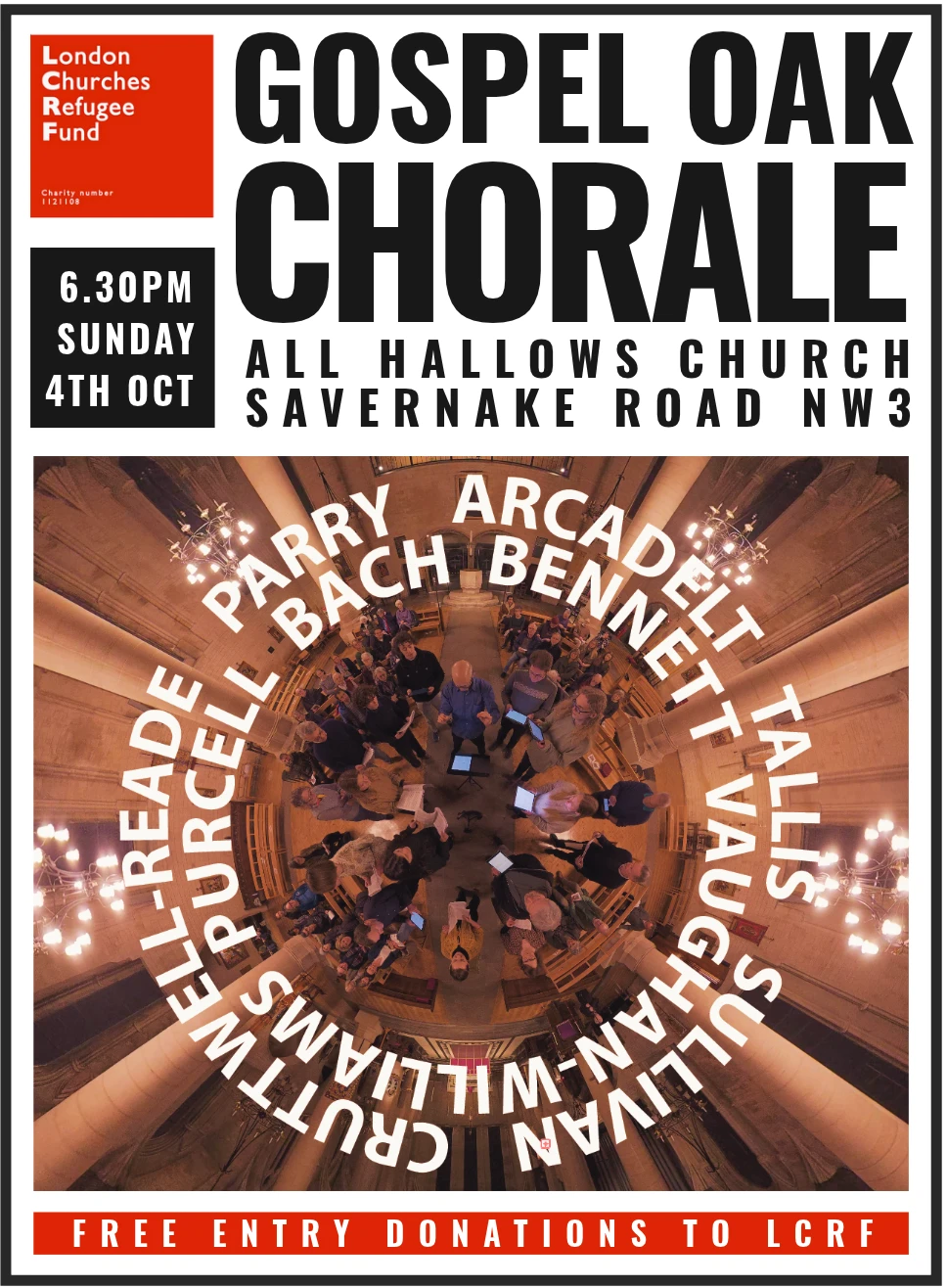
Along with a few friends, I’ve become a hostage to the aforementioned awkward questions, and we’re currently putting on small, experimental concerts every three months at All Hallows’ Church, Gospel Oak, a building with a remarkable acoustic, which sits at the bottom of Hampstead Heath in London. On 4th October, 2026, we gave our fourth free, un-ticketed performance, combining choral music, movement, a quartet of clarinets, and an experimental electronic instrument, playing music by Bach, Parry, Vaughan-Williams and Tallis, amongst others. As per our other events, we invite donations to the London Churches Refugee Fund.
Our next performance is t 6.30pm on Sunday 29th November,